_1768872582663.webp)
6 Person Hot Tub vs 4 Person: Which Size Is Better?
If you're deciding between a 6 person hot tub and a 4-person model, the short answer depends on how you plan to use it. For hotels, resorts, and large families, a six-seat spa delivers better utilization, more jets, and a richer hydrotherapy experience per session. A 4-person unit suits tighter spaces or lower-traffic settings. This guide breaks down every factor — from dimensions and jet count to energy costs and maintenance — so procurement professionals and residential buyers can choose with confidence.
Understanding Hot Tub Size and Capacity: Key Differences Between 6 Person and 4 Person Models
Choosing the right spa size affects everything from installation planning to guest satisfaction scores. Getting this decision right from the start saves time and budget.
Physical Dimensions and Footprint
A standard 4-person spa typically measures around 6 ft × 6 ft, while a six-seat model runs closer to 6'8" × 7'4" or up to 7'4" × 7'4". That extra square footage matters when you're laying out a resort deck, villa terrace, or hotel wellness area. Plan your foundation and access routes before ordering.
Seating Capacity and Layout Variety
Four-seat tubs work well for private villas or couples' retreats. A six-seat configuration — like the iParnassus® P660, which features one full lounge seat and five standard seats — allows a mix of reclined and upright positions. That seating variety means guests with different body types and comfort preferences can all find a position that works.
Installation Scenarios: Indoor vs. Outdoor
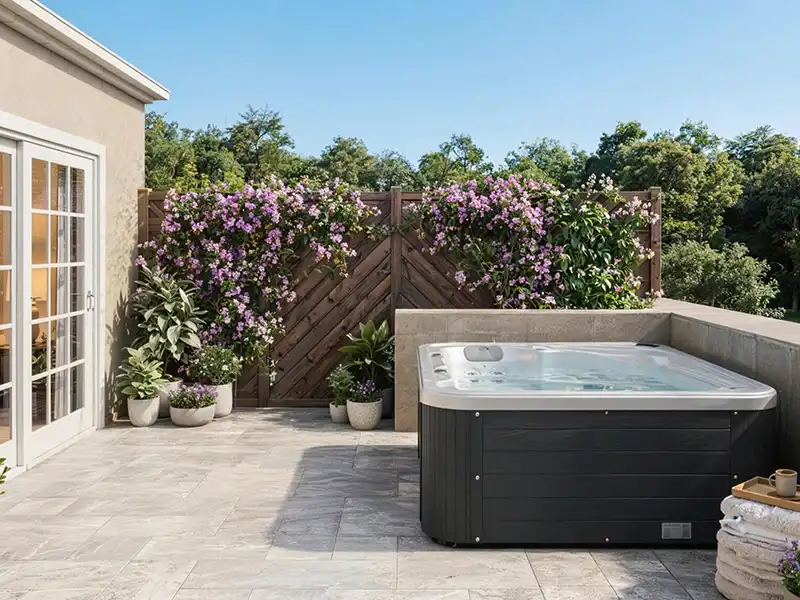
Both sizes can be installed indoors or outdoors, but the larger footprint of a six-seat model requires stronger structural support. A filled six-seat spa can weigh over 3,500 lbs. For hotel rooftops or raised decks, always confirm load-bearing capacity with a structural engineer before installation.
Performance and Operational Analysis: Energy Efficiency, Heating Time, and Maintenance
The prices of a project show if it's a good idea or not. This is how the numbers really look for people who want to buy a business.
Energy Consumption Compared
Because of new building methods that use less energy, the size difference has shrunk. Stats from the industry show that newer spa models use about $1 in electricity every day. More is used by older or less efficient types. Operating costs stay the same because the iParnassus® P660 has two 3HP pumps and insulation that saves energy. This is great for places where utility costs need to be kept low.

Heating Time and Temperature Management
Larger amounts of water take longer to heat up. Three to six seats in a 6 person hot tub can hold around 350 to 450 gallons. Four seats in a tub can hold around 250 to 300 gallons. You can keep the temperature between 100°F and 104°F and use a heated cover that fits well between sessions to speed up the heating process and maintain both sizes' energy efficiency.
Cleaning Cycles and Servicing Intervals
The water in both sizes needs to be changed with the right chemicals two to four times a year. The P660 has an easy-reach backflow valve and an air valve inside the tub that make it simple to make changes. Techs will save time during repair trips, which is helpful for places that are in charge of more than one unit.
User Experience and Health Benefits: Evaluating Comfort, Safety, and Wellness Features
A spa that helps people relax and heal keeps people coming back. Depending on how the jets are set up and how the cabin is made, the experience can be smooth or rough.
Jet Configuration and Hydrotherapy Quality
Where the jets are placed is more important than how many there are. The business world says that each seat should have at least 5 to 6 person hot tub jets, and each pump should have 20 to 30 jets for treatment to work. There are 53 jets spread out over six seats in the iParnassus® P660. It has two 3HP pumps that power it, and ten 5-inch CMP large jets that are designed to massage the back. This is extra, and it makes sure that every seat really feels the pressure.
The main healing areas on the P660 are as follows:
- Back massage: Ten 5-inch large jets target the full back along every seat.
- Hip and foot massage: The lounge seat covers both zones; two standard seats include hip side massage.
- Calf massage: All five standard seats include calf jets for lower-leg relief.
- Shoulder massage: One dedicated seat provides targeted shoulder therapy.
- Shared foot massage area: Available to all seated users in rotation for extended foot relief.
These specific areas work on the stress points that spa-goers most often mention, like sore legs and tight necks. Because of this, the P660 is a great choice for getting back to normal after working out at a spa or on vacation.
Entertainment and Sensory Features
Four speakers are set up in the corners of the P660 so that guests can enjoy both water therapy and music at the same time. The lit-up waterfall makes it look better, and the lit-up cup holder makes it simple to get drinks. People who stay at business properties are happier because of these little things.
Safety Standards and Compliance
It is necessary for business-to-business buyers to follow the rules. If you want to buy a spa for your home or business, make sure it meets the ANSI/APSP-2 standards. The iParnassus® control system protects against not having enough water, extreme high and low temperatures, and being able to track things online from a smartphone. This makes it less likely that hotel and resort owners will be sued.
Market Comparison and Decision Criteria: Choosing Between 6 Person and 4 Person Hot Tubs
When buying something, it's important to think about both the price and how reliable the supplier is.
Price Range and Budget Planning
When it comes to cost-per-user, six-seat spas are better for places with a lot of people. Four-seat spas are usually cheaper and easier on the wallet. Most mid-range to high-end six-seat spas cost between $4,500 and $11,000 from the maker. You'd pay at least $9,000 to $19,000 for a big Western name in a store. When you buy a lot, the price per unit drops even more.
Installation Complexity: Inflatable vs. Built-In
But inflatable hot tubs aren't strong enough or have enough jet power for business use. They're also easy to move and don't cost much to set up. Models made of permanent plastic, like the P660, have stronger frames, more uniform performance, and a longer useful life. This tub's edge on the P660 is wavy, which makes it look good in high-end hotels and villas.
Supplier Capabilities and After-Sales Support
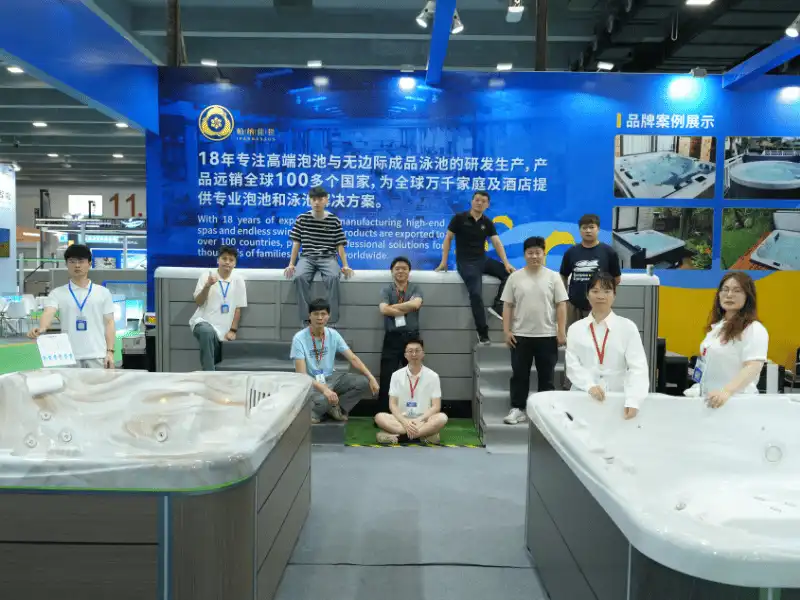
Your money will be safe if you pick a maker whose skills have been proven and whose customer service is easy to get in touch with after the sale. It has been making spas for 18 years and has 80 patents as of 2026. It does business with people in Europe, North America, Australia, and the Middle East.
Final Recommendations: Matching Hot Tub Size to Business Needs
The right size comes down to three factors: expected user volume, available space, and operational budget.
- Choose a 4-person model when space is limited, average daily usage stays below four people, or the budget restricts upfront spend.
- Choose a 6-person model when your property hosts groups, families, or wellness programs where multiple guests use the spa simultaneously.
For most hotels, resorts, and villa projects, the six-seat format delivers a stronger ROI through higher utilization and a broader range of therapeutic features. Properties that have upgraded to six-seat units consistently report better guest feedback related to relaxation and perceived value.
Conclusion
If you want to use a 6 person hot tub for business or a large home, a six-seater with strong jet coverage, energy-efficient construction, and entertainment options works better over the course of a full working cycle. There are 53 fans, two 3HP pumps, built-in speakers, and smart settings on the iParnassus® P660, which makes it a good choice in this area. It's built to last, even if you use it a lot. Think about how much room you have, how many people will be coming, and what qualities are most important to you. Then, decide what to do based on facts, not guesses.
FAQ
1. How much does it cost to run a 6-person hot tub monthly?
How much it costs to run depends on where you live and how well your model works. Most people and businesses spend between $20 and $75 a month, and $20 to $50 of that goes to energy. Newer ones that have good insulation use an average of $1 a day for electricity.
2. How many jets should a six-seat spa have?
Each seat should have at least five to six jets, and each massage pump should have twenty to thirty jets. The iParnassus® P660 has 53 jets, which is more than this standard, and is powered by two 3HP pumps. That's eight to nine jets for every seat.
3. Can a six-seat spa be moved after installation?
Plastic models that stay in place aren't meant to be moved around a lot. A blow-up unit might work if you need something that is easy to move, but it won't have the same jet strength or last as long. If you want to use it for business, think about where you will put it before you buy it.
4. How often does the water need changing?
As long as they get regular chemical care, most spas, no matter how big or small, need to have their full water changed two to four times a year.
Connect With iParnassus® — Your Trusted 6 Person Hot Tub Manufacturer
For 18 years, iParnassus® has been making spas that work well in tough business venues. We sell the P660 6 person hot tub through our network. It has 53 jets, two 3HP fans, smart settings, and an energy-efficient design. We can help you find the right model for your project, whether you're building a resort, fitting out a villa, or giving a distributor a lot of them to buy. Feel free to email us at info@iparnassus.com to ask for a meeting.
References
1. Association of Pool & Spa Professionals (APSP). ANSI/APSP-2 Standard for Portable Spas. APSP, 2014.
2. Spa Industry Association. 2023 U.S. Spa Industry Study. Spa Industry Association, 2023.
3. Consumer Energy Center, California Energy Commission. Spa and Hot Tub Energy Efficiency Guide. California Energy Commission, 2021.
4. Griffiths, T. Aquatic Facility Management. Human Kinetics, 2019.
5. National Swimming Pool Foundation. Pool & Spa Operator Handbook. NSPF, 2022.
6. American Institute of Architects. Building Design for Hospitality and Wellness Facilities. AIA Press, 2020.

Send Inquiry