6 Person Hot Tub vs 8 Person for Sizing a Resort Spa Deck
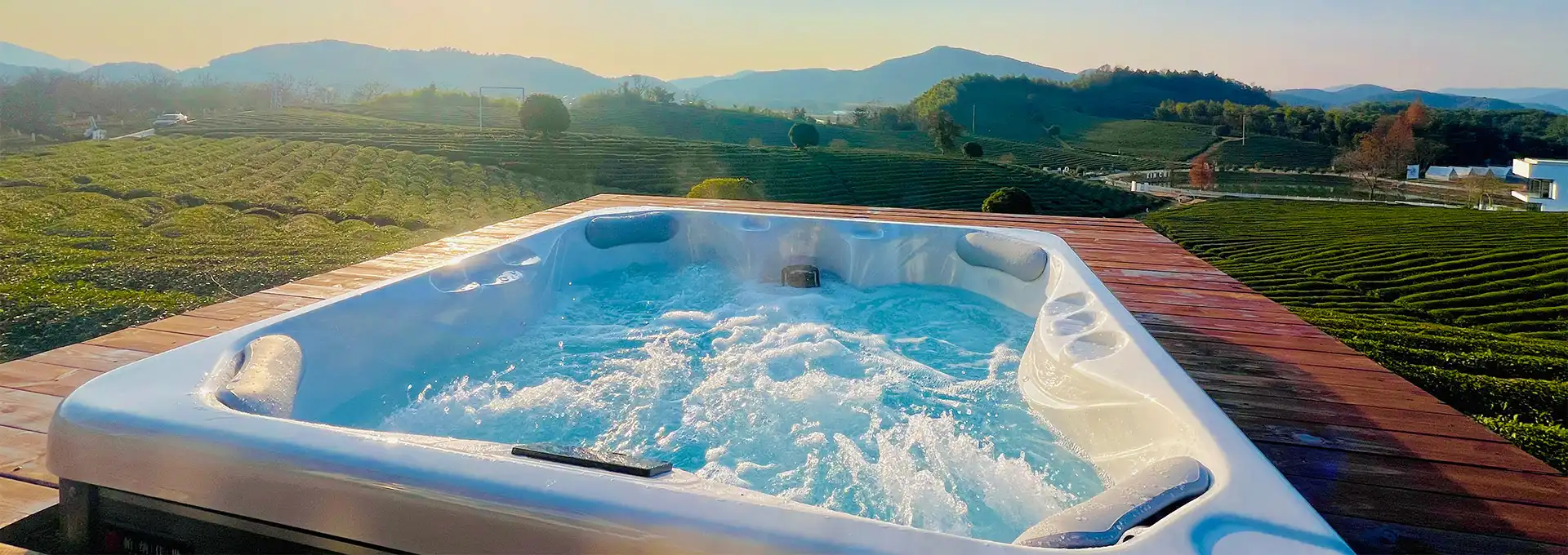
Choosing between a 6 person hot tub and an 8-person model is not just a matter of how many people can fit in the water. Your choice impacts the circulation space, sitting comfort, visual balance, installation costs, and the number of visitors who may use the facility at the same time, all important considerations for a resort spa deck. A bigger spa can seem good, but it might take up precious deck area that could be better used for loungers, covered seating, or a clear path. Shenzhen Iparnassus Intelligent Spas Co., LTD P660 6-person hot tub featuring 1 lounge seat, 5 standard chairs, 53 massage jets, and 2 3 HP water pumps. It measures 210 by 210 cm, a good yardstick to judge how many guests a resort truly needs to accommodate. The optimum pick is the type that suits the visitor profile and deck arrangement of the property, not necessarily the one with the most seats.

Start With the Resort's Real Guest Pattern, Not the Seat Label
When Does a 6 Person Hot Tub Make More Sense?
A 6-person hot tub would suit boutique resorts, private villa terraces, and smaller hotel spa decks where visitors are likely to come in couples, families, or small groups. It's big enough to share an experience, but not necessarily huge enough to need the footprint of a larger community spa. The iParnassus® P660 measures 210 x 210 x 90 cm and has six assigned seats (including one lounge position). This layout provides operators with a reasonable balance between communal bathing and private comfort. A hot tub with room for six may be especially well suited in cases where the resort already has a pool or beach club, as the spa becomes a secondary element for relaxation rather than the property’s main water attraction. The essential issue for procurement teams is how many visitors are expected to be using the spa at the same time during regular times of operation. Planning around normal occupancy will typically result in a more efficient deck than planning just for the occasional high demand.
What Extra Value Can an 8-Person Model Provide?
An 8-person hot tub makes sense when the resort often sees bigger groups, family get-togethers, health programs, or social occasions when more visitors wish to enjoy a spa. This may cut waiting times under sustained high demand, especially in a central wellness area servicing many housing units. But just because it's an 8-seat designation doesn't mean eight folks will be equally comfortable. Usability comes down to seat depth, body posture, footwell room, lounge arrangement, and the actual inside architecture. A 6-person hot tub with good seating may be a better experience than a bigger model with tight seats. Buyers of resorts should ask for the seating layout and, if feasible, arrange to see a demonstration of the product before they commit themselves. The excess capacity is only worth it if there is an actual operational requirement for it. A bigger spa might take up deck space without an equivalent increase in client pleasure if the resort's visitors mostly stay in individual villas or schedule treatments in small groups.
Compare the Full Footprint, Including the Space Around the Spa
The deck size is calculated based simply on the outside measurements of the spa. Guests need enough area to go to the unit, take their shoes off, put down towels, securely get in and out, and walk about without bumping into another guest’s personal space. Staff must have access for cleaning, water testing, equipment inspection, and normal maintenance. A 6-person hot tub with a footprint of 210 x 210 cm has a nominal base area of 4.41 m²; however, the real planning zone must be greater. An 8-person model may need a broader circumference, although the precise difference depends on the form and design. So the deck plan should be based on the designs from the manufacturer, not on a generic seat quantity sheet. The first sketch should include stairs, cover lifters, handrails, privacy screens, and service-panel clearance. This avoids a typical design flaw: a spa that is proportioned for the paper but, if the surrounding furnishings and circulation paths are considered, has little usable area.
| Resort planning factor | 6-person configuration | 8-person configuration |
|---|---|---|
| Typical role | Private or semi-private group relaxation | Larger shared bathing sessions |
| Deck footprint | Often easier to integrate into compact layouts | May require a larger dedicated zone |
| Guest pattern | Couples, families, small groups | Larger families, social groups, higher simultaneous demand |
| Seating assessment | Check lounge and standard-seat balance | Check whether all positions offer practical comfort |
| Design priority | Efficient use of limited deck area | Capacity and circulation around a larger unit |
| Procurement check | Confirm exact dimensions and service clearance | Confirm exact dimensions, filled weight, and access needs |

What the P660 Brings to a Resort Spa Deck
Six Seats With a More Varied Massage Experience
The P660 is much more than just a 6-seater warm water container. The seating arrangement consists of one lounge seat and five conventional chairs to provide the customers with multiple ways to enjoy the spa. According to the standard, there are 53 staggered jets of varying diameters to provide a range of water flows and massage effects. There are ten big five-inch jets for the back massage, and the lounge position has a foot and hip-side massage. Two more chairs have hip-side massage, and all five basic seats have calf massage built in. A shared foot-massage space is another option to enjoy the jet layout while taking turns. For resort owners, this versatility makes the hot tub supplier for landscape contractors to visitors with diverse relaxing preferences. It's not only about capacity; the product also delivers a richer experience that can be articulated via room descriptions, spa menus, and luxury villa packages.
Lighting, Music, and Details That Shape the Atmosphere
A resort spa deck is a visual and sensual experience, particularly when it faces a garden, a coastline, or an infinity pool. The P660 has a long lit waterfall to provide movement and visual interest to the spa area. There are four speakers in the four corners, so visitors may enjoy music while bathing. The lighted cup holder adds convenience, and the ripple-patterned rim provides a beautiful accent inspired by the rings of water spreading from a falling droplet to the outside. These elements may assist the 6-person hot tub to blend into the architectural language of the resort, rather than seeming like a stand-alone piece of equipment. Design should examine how the waterfall lighting looks after sunset, how well the speaker placement fits with the acoustic environment of the deck, and how the spa finish works with stone, wood, tile, and outdoor furniture. The aim is for a uniform environment that seems meaningful to the visitor at first sight.
Easy-to-Reach Controls Support Guest and Staff Use
A spa that is utilized in a hospitality context must be easy to use for visitors and running personnel. According to the accompanying P660 product brief, the diverter valve and air valve are conveniently placed within easy reach within the tub so customers may change water-flow and air settings without having to hunt around the outside. That might potentially make the experience more natural for clients who wish to alter the massage feel mid-session. The 53 jet arrangement is powered by two 3 HP water pumps as specified in the stated power configuration. Buyers should check final electrical specifications, control system, heating configuration, and installation requirements in the technical quote from the manufacturer. Housekeeping and maintenance staff have well-written operating procedures, and it is simpler to handle with a 6-person hot tub. Resorts should inquire about user instructions, tips on water maintenance, information on replacement parts, and specifics on after-sales service before they buy. These practicalities are as important as the cosmetic aspects if the spa is going to run on a regular basis.
| P660 feature | Product specification supplied | Potential value for resort operators |
|---|---|---|
| Seating | 1 lounge seat + 5 standard seats | Supports different bathing positions |
| Massage jets | 53 staggered jets | Provides varied massage zones |
| Large back jets | 10 × 5-inch jets | Creates a dedicated back-massage feature |
| Water pumps | 2 × 3 HP | Supports the specified jet configuration |
| Lounge massage | Foot and hip-side massage | Adds a more targeted lounge experience |
| Standard-seat massage | Hip-side massage on two seats; calf massage on all five | Offers varied treatment positions |
| Atmosphere | Illuminated waterfall and four speakers | Enhances the visual and audio experience |
| Convenience | Lighted cup holder; accessible diverter and air valves | Makes in-spa adjustments easier |

Design the Deck Around Movement, Views, and Guest Comfort
Keep Walkways Clear When Choosing Between Six and Eight Seats
A resort deck should not seem cluttered with multiple nice features. Guests should have easy access from the spa to the changing facilities, showers, loungers, and other outdoor areas. If the main pathway is squeezed into a tiny passageway by an 8-person hot tub, the additional seats may come at the price of the whole experience. Depending on the size of the deck, a 6-person hot tub may provide greater flexibility for a towel station, side tables, planting, or covered seats. Designers must design the expected flow of customers and personnel, including the path needed for bringing cleaning supplies and maintenance equipment into the spa. The arrangement should also stop wet-foot traffic from crossing popular dining or bar sections. For a resort that aims to have a quiet, premium ambiance, ample circulation might be more important than putting in two occasional bathing positions. Always verify local building, fire, and accessibility restrictions before completing the deck layout.
Consider Accessibility, Entry Points, and Service Access
A decent spa deck should be friendly to customers with all varied mobility demands. The design team should consider the path between the guest accommodation and the spa, suitable accessible ways of entrance, handrail or transfer arrangements, and slip-resistant surfaces. U.S. GetBoard’s guidelines on swimming pools, wading pools, and spas in the United States specify accessibility requirements for spas, including how to get admission. Different jurisdictions have different requirements; thus, overseas resorts should examine the regulations in their region. You may also want to consider how much space is left for an accessible approach and transfer area when deciding between a 6-person hot tub and an 8-person hot tub. Maintenance access is equally crucial. Permanent seats, plants or ornamental cladding should not obstruct equipment panels. A well-planned 6-person hot tub installation will provide adequate room for visitors to enjoy it comfortably and for personnel to service it without having to dismantle the surrounding deck.
Use the Resort's Landscape to Make the Spa Feel Integrated
The most effective spa decks link the hot tub supplier for landscape contractors to the surrounding architecture and surroundings. Consider the view from the lake, the direction of the afternoon sun, exposure to wind, seclusion, and how the spa relates to other outdoor amenities. The six-seater form may be used as a small party spot near a villa terrace or as a more private escape next to a planted leisure area. If a group activity is part of the essence of a resort, an eight-seat model could be more appropriate for a central deck. A good hospitality case study is the LIOQA Resort on Croatia's Ugljan Island. The official website shows the individual villas with terraces, gardens, infinity pools, and breathtaking sea views, while the VIVA Beach Club serves as the common social hub. This shows how a single property may provide both private leisure and social facilities to meet the demands of diverse guests. This kind of tiered experience may be augmented with a 6-person hot tub without conflicting with the main pool or seaside gathering spaces.

Make the Final Choice With Operating Costs and Demand in View
Compare Water Capacity and the Complete Installation Load
Water volume is a crucial consideration in spa design as it impacts the filled weight, heating demand, and water-treatment needs. The P660 is rated at 1,395 L water capacity, and this is about 1,395 kg of water before adding the spa shell, equipment, occupants, and any supporting structure. The total operating load must be checked against the manufacturer's empty weight and desired number of users. 8-person spas can carry more water, but you can’t tell the difference just by looking at how many people it fits. Some of the models have efficient designs, while others have deeper or larger basins. For a raised resort deck, a certified structural engineer should analyze the slab, beams, support points, and planned position. The 6-person hot tub should be seen as a fully integrated system, not just a product with a square footprint. The Uniform Swimming Pool, Spa and Hot Tub Code and applicable local building standards give important technical background, but it’s up to the project engineer to establish which regulations apply to the property.
Estimate Water Care, Energy Use, and Staff Workload
Sure, a bigger spa may entail heating and treating more water, but the real difference in operation is determined by factors like insulation, cover efficiency, heater power, surrounding temperature, how often it is used, and maintenance routines. Resort purchasers can ask for similar energy and water-care details on the specific six- and eight-person versions they are considering. The published site for the P660 shows a capacity of 1,395 L, 53 jets, and two 3 HP pumps. These specs assist in defining the equipment profile but, by themselves, don't provide a good approximation of the energy use per day. Ask the supplier for specifics about heater specifications, electrical requirements, filtration requirements, suggested operating parameters, and maintenance intervals. If you have a small property and your visitor demand is modest, a 6-person hot tub may be simpler to accommodate into your daily operations. But the optimum model is one that reflects actual consumption but also allows personnel to maintain constant water quality and service standards. A fair comparison of operational costs should be based on manufacturer data, not guesses based on seat count.
Select a Supplier Who Understands Hospitality Projects
Product selection is only one aspect of procurement for resort developers. The supplier should include technical drawings, installation guides, electrical paperwork, maintenance instructions, warranty conditions, and a clear method for after-sales support. This is especially the case whether the spa is to be put in a seaside location or as part of a multi-unit villa development. Shenzhen Iparnassus Intelligent Spas Co., LTD specializes in hot tubs, swim spas and cold plunge products, and has teams spanning design, R&D, manufacturing, sales and after-sales support. By 2026, the firm will have 18 years of spa expertise and 80 patents. Its iParnassus® brand services Europe, Australia, the Middle East & North America. If you are a hot tub provider to landscape contractors, villa developers, or resort procurement managers, request the full P660 technical package and cross-check against the real deck plans. If you have a supplier that can take the project beyond the catalog stage, it makes the purchase process so much more predictable.

Conclusion
When deciding between a 6 person hot tub or an 8-person hot tub, start with the behavior of your guests, the space available on your deck, and the experience you want to create at your resort. The iParnassus® P660 is an attractive solution for boutique resorts and villa properties with six chairs, one lounge position, 53 jets, two 3 HP pumps, and a size of 210 × 210 cm. If you often have bigger groups, an eight-person spa may be a better option, but the extra capacity has to be justified by the space and operational needs. Compare real dimensions, seating configurations, water capacity, service access, and total installation loads before you decide. The spa can be a natural extension of the resort’s nature and a memorable guest amenity with strategic design and the appropriate vendor.
FAQ
1. What are the dimensions of the iParnassus® P660?
The P660 measures 210 × 210 × 90 cm.
2. How many people can the P660 accommodate?
It is designed for six people, with one lounge seat and five standard seats.
3. How many jets does the P660 have?
The product brief specifies 53 staggered jets in different sizes.
4. Is a 6-person hot tub suitable for a resort spa deck?
Yes. It can suit boutique resorts, villas, and smaller spa decks when its capacity matches expected guest demand and the deck has adequate structural support and circulation space.
5. Should a resort choose an 8-person spa for higher guest capacity?
Only if larger groups regularly use the spa together and the deck can accommodate the model, access routes, and service clearances.
Create a More Inviting Resort Spa Deck with iParnassus®
The right 6 person hot tub can turn an ordinary outdoor deck into a memorable place for guests to relax, reconnect, and enjoy the resort environment. The iParnassus® P660 combines six-person seating with a lounge position, 53 massage jets, an illuminated waterfall, and four built-in speakers—features that bring both comfort and atmosphere to hospitality spaces. Whether you are developing a boutique hotel, a private villa resort, or a shared wellness deck, Shenzhen Iparnassus Intelligent Spas Co., LTD can help you review product specifications and identify a suitable configuration. Share your deck dimensions, project location, expected guest capacity, and preferred installation quantity to begin a more focused discussion. Contact info@iparnassus.com to request P660 product details and explore a hot tub solution for your next resort project.

References
1. Shenzhen Iparnassus Intelligent Spas Co., LTD. 6 Person Hot Tub P660: Product Specifications and Features.
2. Jacuzzi®. Hot Tub Sizing and Seating Guide.
3. U.S. Access Board. Chapter 10: Swimming Pools, Wading Pools, and Spas.
4. International Association of Plumbing and Mechanical Officials. 2021 Uniform Swimming Pool, Spa and Hot Tub Code.
5. LIOQA Resort. Luxury Villas and Resort Facilities, Ugljan Island, Croatia.
6. Pool & Hot Tub Alliance. ANSI/APSP/ICC-6: American National Standard for Residential Portable Spas and Swim Spas.

Send Inquiry