_1768872582663.webp)
Best 2-3 Person Hot Tubs for Year-Round Use
When sourcing compact spas for commercial or residential projects, 2-3 person hot tubs consistently emerge as the most versatile category. They occupy a footprint typically between 60 and 84 inches in length, yet deliver full hydrotherapy performance comparable to larger units. Whether you manage hotel room renovations, supply distributors across North America, or design boutique resort amenities, the right compact spa model can elevate guest experience without straining your budget or floor plan. This guide gives procurement professionals a practical, evidence-based framework for evaluating year-round performance, certification compliance, and supplier reliability.


Understanding 2-3 Person Hot Tubs: Features, Benefits, and Market Needs
A compact, well-engineered hot tub is not just a scaled-down replica of a bigger hot tub. The top units in this category achieve ergonomic seating configurations, zonal jet systems, and energy-efficient heating technologies in a compact size. Most versions built for two to three people are 5 to 7 feet long or broad, so they’re at home in hotel rooms, villa terraces, and small backyards equally. For B2B purchasers, the key differentiation is the amount of therapeutic value the unit provides per square foot of occupied space.
According to the Worldwide Wellness Institute, the worldwide spa and wellness business has surpassed $5.6 trillion, and hydrotherapy equipment is being rapidly adopted in boutique hotels. This is a move toward smaller, purpose-built wellness facilities rather than huge communal ones.
The following are the key market factors for tiny spa models' demand:
- Space efficiency: Hotel project managers and villa developers are facing tighter floor layouts more and more. A small spa that seats three comfortably, with no wasted volume, is a direct operational asset.
- Reduced energy overhead: Less water volume heats quicker, holds temperature better, decreasing kilowatt-hour costs in high-turnover commercial applications.
- Intimate guest experience: A hospitality study published by Cornell Hospitality Quarterly found couples and small families consistently rated private hydrotherapy settings better in satisfaction surveys than communal pool surroundings.
- Logistics benefit: Compact units are more easily shipped. With 6 units per 20-foot GP container, for example, per-unit freight costs are much lower for wholesale distributors.
Together, these characteristics explain why the 2-3 person hot tubs category has become a procurement priority across hospitality, luxury residential, and distribution channels internationally.

How to Choose the Best 2-3 Person Hot Tub for Year-Round Use?
If you’re looking for a year-round spa model, you have to evaluate performance beyond the showroom. Before entering into any supplier relationship, procurement managers should consider the following factors.
The most important contributor to the performance of hydrotherapy is the quality and arrangement of the jet. For a hot tub in a pool, the depth of therapy is related to the diameter and pressure output of each individual jet. Independent assessments of hydrotherapy equipment indicate that 5-inch CMP jets are among the biggest on the market, and they give a better back and muscular massage than normal 3-inch jets.
Commercial purchasers who operate in foreign marketplaces do not negotiate conformance to certification. A good mini spa has to be fully certified for electrical safety, water quality regulations, and structural integrity. There are six globally recognised certifications that offer the compliance covering required for hotel procurement in Europe, North America and elsewhere.
Lock system design is quite important in an unsupervised business context. A triple lock system combines panel lock, kid lock and hotel lock, and removes the liability risks single lock units can’t. But this standard is typically missing on consumer-grade devices but is critical for installations in hospitality.
Water change speed directly impacts room turnover rates. A fast-fill and fast-drain system lowers changeover time between guest usage – a practical benefit that delivers a demonstrable revenue effect in high-occupancy buildings.
Customers working directly with the manufacturer, rather than via multi-tier distribution systems, may meet these standards on a mid-range budget of $3,000-$8,000.

Top-Rated 2-3 Person Hot Tubs of 2026: Comparative Analysis
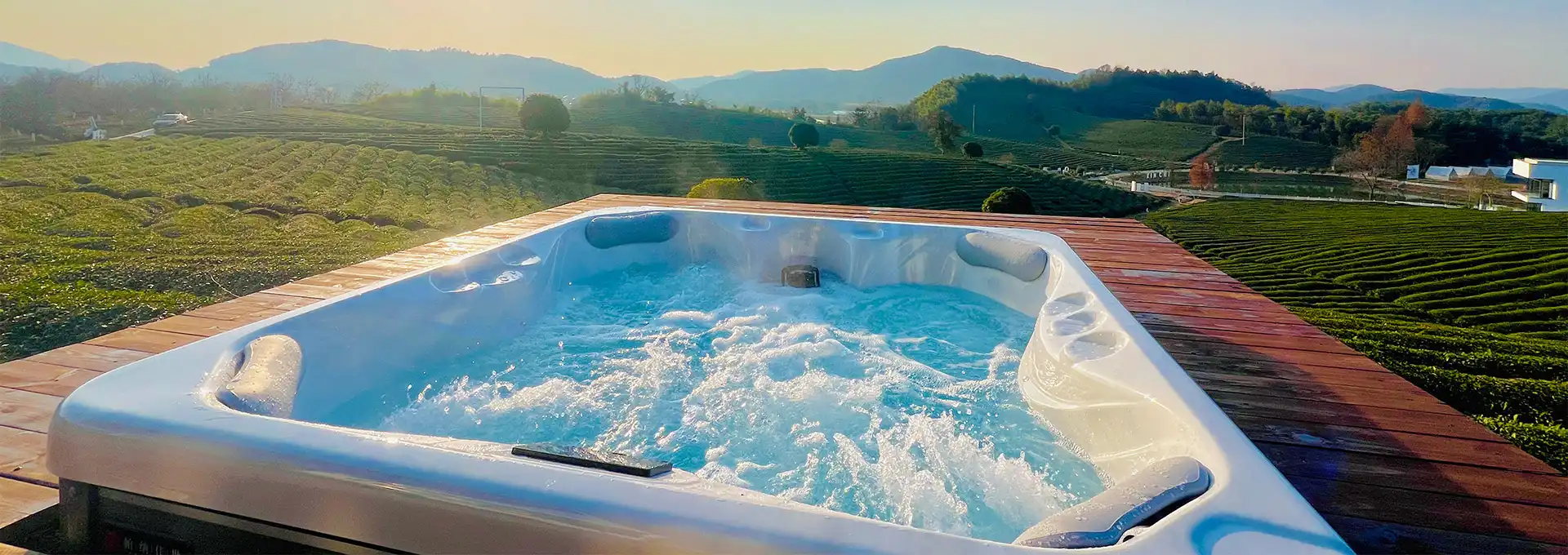
The iParnassus® P630 is one of the tiny spa models for B2B customers in 2026 that is notable for its mix of therapeutic depth, safety design, and operational efficiency. The design has been adapted for three people, with two lounge chairs side by side and one independent compact seat opposite. This creates a well-balanced arrangement for couples, small families, or rotating hotel guests.
Here are the main performance benefits of the P630:
- 39 staggered jets of varied calibres driven by two 2HP water pumps provide layered hydrotherapy modes that target different muscle areas concurrently instead of providing consistent pressure throughout.
- Four 5-inch large jets are devoted to the back muscles, a feature that positions this device in the top tier of small spas in its category.
- Dedicated zone massage: All lounge chairs include foot massage jets and hip side jets. The independent seat has calf massage nozzles, providing focused treatment to each user.
- A pair of skimmer filters gets rid of dead spots in the filtration, which keeps the water clean throughout the entire circulation cycle. This is a real benefit when a hot tub in a pool is used in commercial situations where compliance with water quality is monitored.
- Four-corner stereo speakers provide immersive audio built directly into the spa construction, so there’s no need for extra equipment.
- The LED-lit waterfall element adds to the visual environment without adding installation, a detail that is appealing to resort designers looking for ambient uniqueness.
The P630 has a water diverter valve and air control valve accessible from within the tub, so bathers may change settings without leaving their soak. The outer panel has a water ripple pattern design that conveys a sense of high workmanship at the moment of visual contact—which is significant to hotel buyers who know that aesthetic presentation impacts visitor impression.
These standards together address the pain areas most often raised by procurement managers: suboptimal jet performance, subpar water maintenance, safety gaps in unsupervised environments, and delayed operational turnover.

Maintenance Tips and Energy Management for 2-3 Person Hot Tubs
A full commercial capacity compact spa needs a maintenance routine that can handle its throughput needs. Achieving proper water chemistry, such as maintaining pH levels of 7.2 to 7.8 and sanitiser levels as recommended by the manufacturer, also helps prevent biofilm development and extends the life of the components. The U.S. Centers for Disease Control and Prevention advises testing of commercial spa water at least twice daily during peak-use times.
Filter change-out schedules should be based on actual use volume and not calendar time. In high-turnover hotel situations, a feasible baseline is rinse cycles every 48-72 hours and thorough chemical cleans every two to four weeks. Some of the types, like the P630, employ a twin skimmer filter design that helps lessen the maintenance load by giving continuous circulation without having to do it manually between guest usage.
-- Thermostatic regulation and insulation quality are key to energy management. In areas with large overnight temperature swings, it is more energy efficient to keep water at a constant fixed temperature than to cycle it down between uses. The acrylic shells are well insulated with full-foam cabinet construction to keep the heat in effectively, decreasing heating cycles and, with it, energy demand.
Trusted Brands and Procurement Channels: How to Source the Best 2-3 Person Hot Tubs?
The small spa market is populated by both well-known consumer brands and specialised commercial producers. Manufacturer-direct relationships win every time over multi-tier distributor models on overall cost and response when B2B customers are focused on certification depth, OEM capabilities, and logistical efficiency.
iParnassus® has 18 years of expertise in the manufacture of spas, with 80 patents and commercial installations in Europe, North America, the Middle East and Australia. The control system directly supports hotel management workflows with smartphone remote access, real-time water level monitoring, self-protection for water scarcity and temperature anomalies, and one-key remote lock. The acrylic shells come from U.S. vendors and fulfil the material requirements needed in upscale hospitality locations.
The P630’s dimensions are also optimised for loading efficiency, supporting 6 units per 20ft GP container, a logistical standard that saves per-unit freight cost and streamlines inventory planning, important considerations for wholesale distributors.

Conclusion
Compact spas in the 2-3 person hot tubs category represent one of the highest-value procurement decisions available to hotel project managers, resort designers, and wholesale distributors operating in the current wellness market. The right model delivers meaningful hydrotherapy performance, meets international certification requirements, and withstands the operational demands of year-round commercial use. The iParnassus® P630 exemplifies what purpose-built commercial design looks like in this category: targeted jet architecture, robust safety systems, efficient water management, and aesthetic quality that supports premium hospitality positioning. Procurement decisions grounded in these criteria deliver measurable returns across guest satisfaction, operational efficiency, and long-term durability.
FAQ
1. How much energy does a 2-3 person hot tub typically consume?
Energy consumption varies by model, insulation quality, and climate. A well-insulated compact spa operating at a consistent set temperature typically draws between 1 and 3 kilowatts per hour during active heating. Models with thermostatic control and full-foam insulation reduce overall consumption significantly compared to units that rely on thin shell insulation alone.
2. Can a compact spa be used year-round in cold climates?
Yes, provided the unit is engineered for outdoor temperature variation. Quality acrylic shells, full cabinet insulation, and freeze protection programming allow year-round operation in climates with sustained sub-zero temperatures. The iParnassus® control system includes automatic low-temperature protection as a standard feature.
3. What certifications should a commercial hot tub carry?
For deployment in European and North American hospitality markets, a unit should carry certifications covering electrical safety, structural integrity, and water system compliance. A six-certification suite provides the broadest coverage for global commercial procurement.
4. How quickly can a 2-3 person hot tub be refilled between guest uses?
Fast-fill and fast-drain specifications vary by model. Units designed for commercial turnover support significantly shorter changeover windows than residential-grade alternatives, directly affecting room availability scheduling.
Ready to Source Premium Compact Spas? Contact iParnassus® Today
iParnassus® is a trusted manufacturer of high-end wellness equipment, including 2-3 person hot tubs, with 18 years of commercial spa experience, 80 patents, and certified deployments across four continents. Our P630 and full product range are engineered for year-round reliability in hotel, resort, and distribution environments. Whether you need bulk order pricing, OEM configuration, or a customized procurement consultation, our team responds with the technical depth your project requires. Contact us at info@iparnassus.com to request your catalog today.

References
1. Global Wellness Institute. Global Wellness Economy Monitor. 2023.
2. Cornell Hospitality Quarterly. Guest Satisfaction Drivers in Boutique Hotel Amenities. 2022.
3. U.S. Centers for Disease Control and Prevention. Healthy Swimming: Maintaining Safe Hot Tub Water. 2022.
4. Association of Pool & Spa Professionals (APSP). ANSI/APSP/ICC-2 Standard for Portable Spas. 2014.
5. Swim University. Hot Tub Maintenance: The Complete Guide. 2023.
6. Energy Star Program, U.S. Environmental Protection Agency. Energy Efficiency in Residential Spa and Hot Tub Products. 2021.

Send Inquiry